 |
The New Mythology of the Space Age by Sylvia Engdahl (Page 16 of 16) |
 |
|
The New Mythology of the Space Age by Sylvia Engdahl (Page 16 of 16) |
|
|
The New Mythology of the Space Age |
|
| by Sylvia Engdahl (Page 16 of 16) | ||
29. Gaia/Mother Earth Mythology
This section has been replaced by my nearly-identical essay The Meaning of Gaia in Space Age Mythology, which appears both at this website and in my ebook The Future of Being Human and Other Essays. .
30. The Future of Space Age Mythology
We have seen that since the advent of the Space Age, metaphors expressing views of the universe and of our place in it have become common in our culture. But do these metaphors constitute an actual body of mythology-- albeit one not self-consistent--or are they merely trendy? How do we know that space movies, for example, won't fade in popularity, just as cowboy movies have faded? How do we distinguish myth from fad?
There is no sure way to tell, of course. Conclusive evidence will be obtainable only with hindsight: myth endures as long as a culture's worldview endures; fashion doesn't. But certain criteria do reveal the extent of a metaphor's appeal, and thus of the depth of feeling it reflects. Fads are based on superficial feelings, not deep underlying ones. So, if we judge the popularity of a metaphor to be wide and persistent, the chances are that it's more than a fad, and that, by examining it, we can gain insight into the outlook of the culture in which it has emerged.
The size of the audience drawn to a science fiction work has, so far, been the major objective measure of its mythic power. Also, the lasting pull of such a work is an important indicator: for example, the original Star Trek series is even more popular now [in 1994], after countless reruns, than when it was first a hit. However, there is another index of a myth's prominence: the extent to which it's mentioned casually, without explanation, in unrelated media. That is, if allusions to metaphors or characters from space films appear frequently outside science fiction contexts, we can be sure they're meaningful to the public at large.
Such allusions are becoming more and more frequent. Who in our society does not know what is meant by references in mainstream writing to Kirk, Spock, Luke Skywalker or Darth Vader? Or to the Force? The expressions "beam me up" and "warp speed" have passed into our language. At the time of the last presidential election bumper stickers bearing the slogan PICARD/RIKER '92 were in great demand.
Yet there is a far more profound sign of Space Age mythology's significance than the prevalence of specific names: the spread of its themes into genres of fiction other than science fiction. People without background in the publishing industry may miss the importance of this, since to them, "science fiction" may be defined by the presence of such themes in the first place--however, to a writer, it is recognizable as a major development. Until the 90s, publishers were not willing to issue fiction dealing with hypothetical planets, aliens or space travel in lines other than those edited and marketed under an SF imprint and directed to the relatively small audience of established SF fans. (The sole exception, other than for the work of big-name authors, was in the children's literature field; that was why I myself chose to publish in that field.) But recently, such themes have been appearing even in the once-narrow formula romance genre, which has huge press runs, and are now in great demand there. Their treatment in most romance novels, however, shows scant knowledge of space terminology on the part of writers and editors, let alone readers--incredibly, one bestselling trilogy misuses the word "galaxy" in place of "solar system." What this means is that large numbers of average women, without any background whatsoever in science or SF, like to fantasize about visiting distant worlds and falling in love with starship captains or even ETs (as in the movie Starman.) I always predicted this might happen, but was nevertheless surprised to learn that the time is now at hand. There can be no stronger proof that Space Age mythology is here to stay.
Evidence such as this reveals more about our culture's attitude toward the universe than do the rational conjectures of intellectuals. It is fashionable among the intelligentsia to be gloomy. It's considered "realistic" to maintain that our one small planet is all we'll ever have, and that we're on the road to destroying it--when only hard data at hand are considered, many find this an inescapable conclusion. Yet exclusion of all other data is scarcely realism, since it's obvious that our access to knowledge is limited. Thus undercurrents of mythopoeic thought prevail, even when viewed as childish--and certainly when legitimatized by the name of dreams.
Still, there is the alternate mythic undercurrent of fear, which emerges in Earth-worship and, I believe, in the experiences of UFO "abductees." Does this represent a wholly negative view of our species' place in the larger universe? I used to think so; but now, I am not so sure. There is a new phenomenon within the abduction syndrome: some experiencers, and some researchers, are now transforming such fear--of the alien and of human vulnerability--into a positive outlook toward cosmic order.
In reference to supposed alien warnings about Earth's ecological danger, Harvard psychiatrist John Mack, in his book Abduction, writes, "Nothing in my work on UFO abductions has surprised me as much as the discovery that what is happening to the earth has not gone unnoticed elsewhere in the universe. That the earth itself, and its potential destruction, could have an effect beyond itself or its own environment was altogether outside the worldview in which I was raised. But it would appear from the information that abductees receive that the earth has value or importance in a larger, interrelated cosmic system that mirrors the interconnectedness of life on earth." I don't agree with the fundamental premise of Mack's interpretation, which is that whatever the cause of the abduction phenomenon, it "is, at its core, about the preservation of life on Earth at a time when the planet's life is profoundly threatened." In my opinion, there is no real threat, and the genuine perception of threat on the part of his patients--which they construe in familiar terms as destruction of the planet on the part of humans--has its roots in their unacknowledged fear of the environment beyond it. Yet his interpretation in itself is a clear example of that mythopoeic process: the process whereby the known (human damage to this world) becomes a metaphor for the unknown (potential peril to humans from contact with ETs or distant worlds). And this metaphor is closely connected to the source of its drawing power, for envoys from elsewhere are perceived as mediators--almost, perhaps, in the classic structuralist sense of mediation between the dichotomy "dangerous conditions at home" and "dangerous universe." Initially terrifying, they are ultimately seen as proof of Earth's place in a larger scheme.
Not surprisingly, it's common for "abduction" experiencers to be transformed by recognition of such a pattern, whether or not it is articulated, and to be motivated thereafter by constructive, rather than panic-inspired, regard for our planet's welfare. Mack considers this an indication that nonhuman influence of some sort, rather than mere stress, is the cause of their transformation. I say that their confrontation with contemporary myth is responsible. One of the prime functions of mythology is to put us in touch with imagery enabling us to make sense of the cosmos. It would appear that in the case of responsive abductees, it is fulfilling this function very well indeed: though they may still believe literally in Earth's jeopardy, they have come to terms with the idea that we can't remain isolated.
Does this represent a trend in human perception? Are we on the verge of recognizing the threshold at hand not merely in science fiction, where it is easily dismissed as "just fantasy," but in reality? I think perhaps we are. This course focuses on science fiction because it is a Media Studies course, and is mainly concerned with Space Age mythology's expression in the media. But I believe that its other expressions will become increasingly significant. It has been seriously suggested that nonhuman agencies control UFO "abductions"--whether actual or psychically induced--with the aim of accustoming us to the alien and inexplicable. Whether or not this is the case (and I suspect it's not) the phenomenon will surely have that effect, simply through the power of its mythic impact. If its source isn't external, it is at least unconscious, and thus reveals that we're well advanced in the assimilation of our emerging mythology. The era of viewing Space Age metaphors as mere inventions is nearing an end.
Without an appropriate mythology, could our species evolve? I think not. I believe that mythopoeic thought is a primary mechanism of exosmatic evolution (see lecture 14). This is intuitively grasped by by those who credit science fiction with inspiring space travel, and also by many who are studying the alien abduction phenomenon: Mack, for instance, titles his final chapter, "Alien Intervention and Human Evolution," even though he doesn't see our evolution in terms of expansion to a new niche. If there were no Space Age mythology, there would be no Space Age. For that matter, without the human capacity for myth-making, we would still be living in caves.
Someday, we will venture beyond the orbits of this planet and its moon, and
even beyond its solar system. Our mythologies will go with us. No doubt,
most specific metaphors of today's Space Age mythology will prove
nonviable. It can't be compared to ancient mythologies in terms of
duration, since discoveries now come much faster, and what's beyond
comprehension in one century may be understood rationally in the next. Its
fundamental concepts, however--concepts such as the value of exploration
and of friendship with alien species--will surely endure. And there will
always be mysteries, so new mythic ideas will keep arising as the old ones
pass away.
Postscript, 2019
It has been nearly twenty-five years since the last time I taught the course for which I wrote this series, and during that time the darker side of Space Age mythology has become more prominent while the bright side has diminished, at least as far as the general public is concerned. There are, of course, a great many people whose desire to see humans explore beyond this planet has not weakened. And it can still be said that Star Trek and Star Wars have a large and enthusistic following, and that the popularity of romance novels involving aliens is growing, albeit among a somewhat specialized group of readers. But a smaller percentage of the population now welcomes the thought that we are part of a vast and mysterious universe
One form of evidence for this is the increase in pessimistic space movies, which I've discussed in my essay Space Age Mythology Revisited, and the concurrent rise of apocalyptic films expressing deep fears of our planet's vulnerability. Another is the widespread exaggeration of environmental concerns, especially the illusion that Earth can remain unchanged from generation to generation and that we can keep it that way, even to the extent of controlling its climate. And still another is the decline of public support for real space programs, which has puzzled and frustrated space advocates for nearly half a century--contrary to common belief, that loss wasn't due to boredom or apathy. Until recently I did not grasp the ambiguous nature of the mythology that was developing. I now feel that many people's enjoyment of space fantasy was a matter of whistling in the dark.
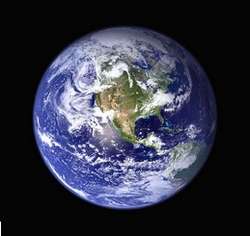
As I said in lecture 14, mythology serves the adaptive purpose of helping people confront the environment in which they perceive their culture to exist. If the perception of the extended environment changes, mythology not only changes but goes through a period of upheaval. When the first photos of Earth as a globe made clear that our world, not just in science textbooks but in reality, exists within a seemingly-endless expanse of empty space, they produced an emotional shock. In part, this was good; people became aware that Earth is beautiful and should be protected from wanton destruction. And some were elated by the possibility of venturing into new regions. But others withdrew by telling themselves either that nothing beyond our planet matters, on one hand, or on the other, that that space travel is merely a fascinating new game to watch. Then came the moon landing, after which it could be dismissed as a game no longer (although some have tried by claming that the landing never happened). Though It took awhile for this reaction to set in, the eventual result was a shift in mythic views of the future.
At first people inwardly disturbed by what Pascal famously described as "the eternal silence of these infinite spaces" were nevertheless drawn to space and had joined the enthusiasts in looking at it, or trying to, as a pleasantly exciting setting for stories; thus in the seventies and eighties optimistic science fiction was popular while at the same time, the moon was abandoned. Until the Challenger disaster (see my page Tragedy in Space) the potential terrors of the unknown were deemphasized, and the idea that if we could travel in space visitors from elsewhere might also do so was dealt with by everyone but UFO believers through the portrayal of such aliens as friendly.
But gradually, this comforting outlook faded. Aliens are now depicted as dangerous; some scientists have begun to say that we shouldn't attract their attention by sending SETI messages. Space activity arouses less interest than it once did, even among children, and the majority of citizens bury their heads in the sand with regard to the fact that a single planet's resources cannot possibly support its population forever. For escapist entertainment, most now look to pure fantasy about magical realms rather than wishing "to explore strange new worlds, to seek out new life and new civilizations, to boldly go where no one has gone before." Unconsciously if not consciously, they would prefer not to think about what lies beyond our home world.
I have come to realize that we should have never have expected it to be otherwise. For the vast majority of humankind, apprehension always has been the underlying reaction to new awareness of our place in the universe. In my essay Confronting the Universe in the Twenty-First Century I compared our present situation to the seventeenth-century spread of knowledge that Earth was not the center of the universe and the stars were not mere lights fixed to a surrounding crystal sphere. That took people a very long time to absorb. And though our forebears did absorb it and become fascinated by the idea of other worlds orbiting other suns, they did not connect that idea with everyday reality. They didn't expect those worlds to have any impact on the inhabitants of this one, let alone imagine that someday mortals might leave it.
Not so today, when for better or for worse, the prospect of contact with the wider universe is before us. And somehow, Space Age mythology will attenuate the terror of it and enable our culture as a whole to meet it with confidence--the metaphors of myth are, after all, how humans deal with the unknown. I cannot guess how soon this will happen. Movement outward from this planet is not as dependent on public support as I and other space advocates once thought; entrepreneurs are beginning to take the initiative, as has happened in all past cases of human progress. New conceptions of reality are always embraced by a farsighted few before being widely accepted. So perhaps, when travel to the moon and Mars becomes routine, mythic expressions of our place in the universe will again serve to inspire the feeling that this is how the future will be, and was always meant to be.
Copyright 1995, 2003, 2019 by Sylvia Engdahl. All rights reserved.
If you got to this page by searching, please read the Introduction to the series.